



Phuket Has a New Water Sport Everyone Is Talking About
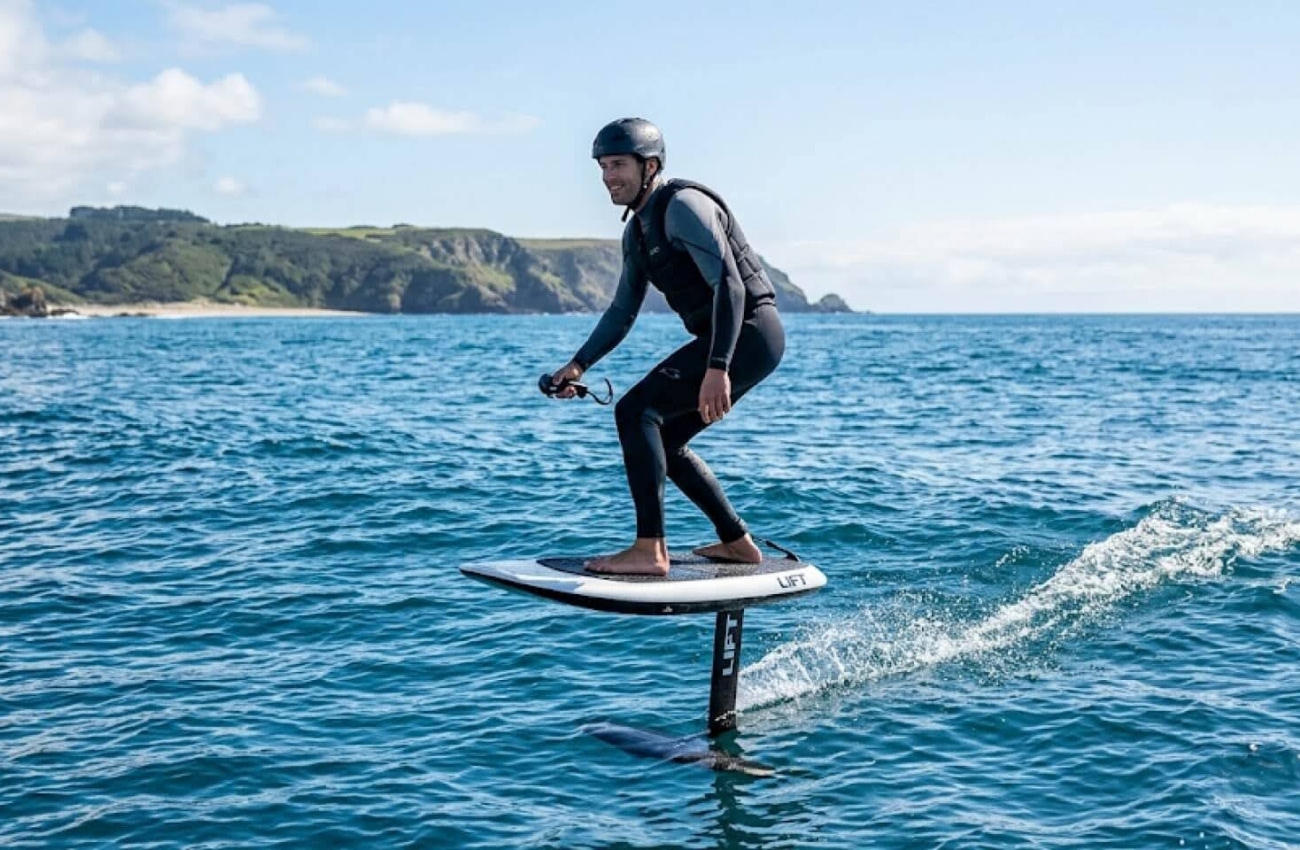
On any given morning at Kata Beach between May and September, you’ll spot something that looks slightly wrong from a distance. A person standing on a board, moving at speed across flat water, with about thirty centimetres of air between the hull and the surface. No sail. No rope. No visible engine wake. Just silence and forward motion, and the faint hum of an electric motor somewhere underneath.
That’s efoil. And it’s been quietly building a following among Phuket visitors who’ve exhausted the usual lineup of jet skis and parasailing and want something that actually requires a skill to do. The electric foilboard has been spreading across Thai waters fast enough that most active beach areas now have at least one operator offering sessions. Understanding what you’re getting into before you book makes the first experience significantly more useful.
What separates this from other water sports on the island
Most motorised water activities in Phuket are passenger experiences. You sit, you hold on, someone else drives. The electric hydrofoil is different in a specific way: the outcome depends entirely on what your body does with the board. The throttle is in your hand via a wireless remote, the foil responds to your weight distribution, and the lift comes when those two inputs align.
That feedback loop is what makes efoil in Phuket genuinely different from booking a banana boat or a wakeboard session with a speedboat. You’re not being pulled or carried. The board rises because you’ve found the right posture and held it long enough for the hydrofoil to do its job. For most people that moment arrives within the first thirty to forty minutes of a session, not at the end of a multi-day course.
The equipment behind this is worth understanding. Foil boards used for instruction reach speeds up to 50 km/h, though lessons operate well below that ceiling. The mast runs about 70 cm below the board’s hull, and you need roughly 1 to 1.5 metres of water depth to ride safely without the foil contacting the bottom. The battery delivers about 90 minutes of continuous use and recharges in 1.5 to 6 hours depending on the setup.
What the learning curve actually looks like
The entry point that catches most newcomers off guard is how much the board communicates through your feet. Surfers sometimes find the first ten minutes easier because they’re already used to reading a board’s response. Beginners with no board sports background usually take a little longer to stop overreacting to small wobbles, but the gap closes quickly once the throttle discipline clicks.
A first session at EasyFlyFoil runs 60 minutes and opens with a land-based theory segment of ten to fifteen minutes. The practical portion covers throttle response, weight shift over the board, and how to fall safely. Every student goes into the water with a helmet, buoyancy vest, lycra, and a radio unit connecting them directly to the instructor throughout the session. That last detail matters more than it might seem: corrections arrive in real time, not between attempts, which is why more than 80% of students achieve sustained lift within their first class.
One of the more consistent patterns instructors observe: riders who’ve watched a lot of footage before their session tend to expect more drama from the lift-off moment. In reality it’s gradual. The board rises slowly, then holds. The sensation is less of a sudden jump and more of the water simply getting further away while you stay level.
How Phuket’s Coastline Shapes the Wind Seasons
Kata and Soi Phon Chalong sit on Phuket’s west coast, facing the Andaman Sea. Between April and October, the prevailing swell drops and both bays settle into the kind of flat, clear water that makes efoiling accessible for riders at every level. Water temperature stays above 28°C through this window, and the bay depth close to shore is consistent with what the foil needs to operate cleanly.
Outside that window, the Andaman side picks up weather from the southwest monsoon and conditions become less reliable for lessons. Travelers arriving between November and March have a practical alternative: Koh Phangan’s Chaloklum Beach on the Gulf of Thailand side stays protected year-round, with the peak riding period running through the same months that Phuket slows down. For those planning a longer Thailand trip, the two locations complement each other across the calendar. Efoil surfing on Koh Phangan through EasyFlyFoil’s Chaloklum operation runs the same equipment standard and session structure as Phuket, which simplifies things if you’re continuing from one island to the other.
Getting on the water: what to sort out in advance
Session availability at Kata and Soi Phon Chalong is consistent through the Andaman season, but advance booking helps, particularly during peak tourist months. Equipment has a 100 kg maximum rider weight limit. Beyond that, there’s not much preparation required — no prior board sports experience, no swimming test, no special fitness level.
Phone filming during sessions is included at no extra charge. Drone video with editing is available separately at 2,000 THB for those who want a shareable record of the session.
EasyFlyFoil operates in English, Russian, Ukrainian, and Thai, which covers most of the international visitor mix coming through Phuket and Koh Phangan.
The sport is growing across Thailand for a straightforward reason: the gap between watching it and being able to do it yourself is smaller than almost any other activity on the water. One session is enough to find out where you stand.

E-foil surfing instructor
Hello, fellow sailors! My name is Anton and I am your guide in the world of surfing. Let’s dive into the waves together!